POLITICS AS A VOCATION, POLITICS AS A VOCATION, REPRINTED FROM MAX WEBER: ESSAYS IN SOCIOLOGY TRANSLATED, EDITED, AND WITH AN INTRODUCTION BY H. H. GERTH and C. WRIGHT MILLS, NEW YORK OXFORD UNIVERSITY PRESS 1946.
정치의 의미
‘Every state is founded on force,’ said Trotsky at Brest-Litovsk. That is indeed right.
p.3.
Today, however, we have to say that a state is a human community that (successfully) claims the monopoly of the legitimate use of physical force within a given territory.
p.4.
소명에 따른 정치인
‘legitimations’ of this obedience
- traditional
- charismatic
- legal
Hence, ‘politics’ for us means striving to share power or striving to influence the distribution of power, either among states or among groups within a state.
p.4.
There is the authority of the extraordinary and personal gift of grace (charisma), the absolutely personal devotion and personal confidence in revelation, heroism, or other qualities of individual leadership.
p.4.
직업과 소명
There are two ways of making politics one’s vocation: Either one lives ‘for’ politics or one lives ‘off’ politics. By no means is this contrast an exclusive one. The rule is, rather, that man does both, at least in thought, and certainly he also does both in practice. He who lives ‘for’ politics makes politics his life, in an internal sense. Either he enjoys the naked possession of the power he exerts, or he nourishes his inner balance and self-feeling by the consciousness that his life has meaning in the service of a ‘cause.’ In this internal sense, every sincere man who lives for a cause also lives off this cause. The distinction hence refers to a much more substantial aspect of the matter, namely, to the economic. He who strives to make politics a permanent source of income lives ‘off’ politics as a vocation, whereas he who does not do this lives ‘for’ politics. Under the dominance of the private property order, some—if you wish—very trivial preconditions must exist in order for a person to be able to live ‘for’ politics in this economic sense. Under normal conditions, the politician must be economically independent of the income politics can bring him. This means, quite simply, that the politician must be wealthy or must have a personal position in life which yields a sufficient income.
p.9.
전문가
- The clergy
- The humanistically educated literati
- the court nobility
- A patrician stratum, the petty nobility and the urban rentiers, ‘gentry’.
- the university-trained jurist
To an outstanding degree, politics today is in fact conducted in public by means of the spoken or written word.
p.18.
법률가 계급의 역사
the Indian Mimamsa School
ancient Roman jurisprudence by the Italian jurists.
the absolute state
the rise of parties
To take a stand, to be passionate—ira et studium—is the politician’s element, and above all the element of the political leader.
p.19.
the constitutional state
But the use of the printed word is more enduring.
p.19.
언론
journalist
the bourgeois parties
The reason for this lies in the strongly increased ‘indispensability’ of the journalist, above all, of the propertyless and hence professionally bound journalist, an indispensability which is determined by the tremendously increased intensity and tempo of journalistic operations.
p.20.
great capitalist newspaper
정당
Parties, in the sense usual with us, were at first, for instance in England, pure followings of the aristocracy.
p.23.
The members of parliament
the German party organizations
the most modern forms of party organizations
These modern forms are the children of democracy, of mass franchise, of the necessity to woo and organize the masses, and develop the utmost unity of direction and the strictest discipline.
p.25.
Naturally power actually rests in the hands of those who, within the organization, handle the work continuously.
p.25.
The party following, above all the party official and party entrepreneur, naturally expect personal compensation from the victory of their leader—that is, offices or other advantages. ... They expect that the demagogic effect of the leader’s personality during the election fight of the party will increase votes and mandates and thereby power, and, thereby, as far as possible, will extend opportunities to their followers to find the compensation for which they hope.
p.26.
what the old party organization looked like.
the plebiscitarian ‘machine’
지도자
The President, who is legitimatized by the people, confronts everybody, even Congress; this is a result of ‘the separation of powers.’
p.30.
The typical boss is an absolutely sober man. He does not seek social honor; the ‘professional’ is despised in ‘respectable society.’ He seeks power alone, power as a source of money, but also power for power’s sake.
p.31.
The boss has no firm political ‘principles;’ he is completely unprincipled in attitude and asks merely:
p.31.
a strong capitalist party machine
the decisive conditions in German of political management
- the parliaments have been impotent
- the tremendous importance of the trained expert officialdom
- parties with principled political represented bona-fide Weltanschauungen
Consequence. the professional politicians in Germany have had no power, no responsibility, and could play only a rather subordinate role as notables.
소명으로서 정치 관리
the management of politics as a ‘vocation’
a feeling of power
three pre-eminent qualities are decisive for the politician:
- passion
- a feeling of responsibility
- a sense of proportion
One can say that three pre-eminent qualities are decisive for the politician: passion, a feeling of responsibility, and a sense of proportion.
p.36.
To be sure, mere passion, however genuinely felt, is not enough. It does not make a politician, unless passion as devotion to a ‘cause’ also makes responsibility to this cause the guiding star of action. And for this, a sense of proportion is needed. This is the decisive psychological quality of the politician: his ability to let realities work upon him with inner concentration and calmness. Hence his distance to things and men. ‘Lack of distance’ per se is one of the deadly sins of every politician. It is one of those qualities the breeding of which will condemn the progeny of our intellectuals to political incapacity.
p.36.
The ‘strength’ of a political ‘personality’ means, in the first place, the possession of these qualities of passion, responsibility, and proportion.
p.37.
허영
위선. Eitelkeit. the politician’s inward enemy: a quite vulgar vanity
Vanity is a very widespread quality and perhaps nobody is entirely free from it. In academic and scholarly circles, vanity is a sort of occupational disease, but precisely with the scholar, vanity— however disagreeably it may express itself—is relatively harmless; in the sense that as a rule it does not disturb scientific enterprise. With the politician the case is quite different. He works with the striving for power as an unavoidable means. Therefore, ‘power instinct,’ as is usually said, belongs indeed to his normal qualities. The sin against the lofty spirit of his vocation, however, begins where this striving for power ceases to be objective and becomes purely personal self-intoxication, instead of exclusively entering the service of ‘the cause.’ For ultimately there are only two kinds of deadly sins in the field of politics: lack of objectivity and—often but not always identical with it—irresponsibility. Vanity, the need personally to stand in the foreground as clearly as possible, strongly tempts the politician to commit one or both of these sins. This is more truly the case as the demagogue is compelled to count upon ‘effect.’ He therefore is constantly in danger of becoming an actor as well as taking lightly the responsibility for the outcome of his actions and of being concerned merely with the ‘impression’ he makes. His lack of objectivity tempts him to strive for the glamorous semblance of power rather than for actual power. His irresponsibility, however, suggests that he enjoy power merely for power’s sake without a substantive purpose. Although, or rather just because, power is the unavoidable means, and striving for power is one of the driving forces of all politics, there is no more harmful distortion of political force than the parvenu-like braggart with power, and the vain selfreflection in the feeling of power, and in general every worship of power per se. The mere ‘power politician’ may get strong effects, but actually his work leads nowhere and is senseless. (Among us, too, an ardently promoted cult seeks to glorify him.) In this, the critics of ‘power politics’ are absolutely right. From the sudden inner collapse of typical representatives of this mentality, we can see what inner weakness and impotence hides behind this boastful but entirely empty gesture. It is a product of a shoddy and superficially blasé attitude towards the meaning of human conduct; and it has no relation whatsoever to the knowledge of tragedy with which all action, but especially political action, is truly interwoven.

그러므로 정치가는 매일 매순간 매우 경박하고 너무나도 인간적인 하나의 적을 마음속에서 극복하지 않으면 안 되는데, 그것은 바로 아주 세속적인 허영심입니다. 이것은 대의에의 모든 헌신 및 모든 거리─이 경우에는 자기 자신에 대한 거리입니다만─와는 불구대천의 원수입니다.
허영심이란 대단히 널리 퍼져 있는 하나의 성질로서 이것이 전혀 없는 사람은 아마 아무도 없을 것입니다. 그리고 대학사회와 학자사회에서는 그것은 일종의 직업병입니다. 그러나 바로 학자의 경우에는 그것이 아무리 혐오스럽게 나타나고 있다 하더라도, 보통은 학문활동에 방해가 되지 않는다는 의미에서 비교적 해가 없습니다. [그러나] 정치가의 경우에는 전혀 다릅니다. 그는 권력(Macht)을 불가피한 수단으로 추구하면서 활동합니다. 그러므로─사람들이 흔히 말하는 바와 같은─'권력본능(Machtinstinkt)'은 사실 그의 정상적인 자질 중의 하나입니다. 그러나 이 권력추구가 전적으로 '대의'에 봉사하는 것이 아니라, 객관성을 잃고서 순전히 개인적인 자기도취의 대상이 되는 곳에서는 그의 직업의 신성한 정신에 위배되는 죄악이 시작됩니다. 왜냐하면 정치 영역에는 결국 두 가지 종류의 큰 죄만이 있기 때문입니다. 그 두 가지는 객관성의 결여(Unsachlichkeit)와─항상 그렇지는 않습니다만, 흔히 이와 동일시하는─무책임(Verantwortungslosigkeit)입니다. 허영심은 자기를 될 수 있는 대로 뚜렷하게 돋보이게 하고자 하는 욕망인데, 이것이 정치가를 가장 유혹해서 두 큰 죄 중의 어느 하나를, 아니면 그 둘 모두를 범하게 합니다. 데마고그는 '효과'에 의지하지 않을 수 없기 때문에, 한층 더 그러합니다. 바로 이 때문에 그는 항상 배우가 될 위험 속에 있을 뿐만 아니라, 자기 행동의 결과에 대한 책임을 가볍게 생각하면서 자기가 주는 '인상'만을 문제 삼을 위험 속에 있습니다. 그의 객관성의 결여(Unsachlichkeit)는 그로 하여금 실제적인 권력보다는 권력의 화려한 외면을 추구하도록 부추깁니다. 그리고 그의 무책임은 그로 하여금 실질적인 목적도 없이 권력을 다만 권력 자체를 위해서 향유하도록 부추깁니다. 왜냐하면 권력이 모든 정치의 불가피한 수단이며 따라서 권력추구가 그 원동력의 하나임에도 불구하고 아니 오히려 바로 그렇기 때문에, 벼락부자처럼 권력을 갖고서 호언장담을 한다든가, 권력을 지녔다는 생각에서 우쭐대며 자기도취되는 것보다, 일반적으로 말해서 권력 그 자체를 숭배하는 모든 일보다 더 위험한 정치권력의 희화는 없기 때문입니다. 한낱 '힘의 정치가(Machtpolitiker)'에 불과한 사람이라도─우리 나라에서도 그런 사람을 열심히 숭배해서 신성화하려고 애쓰고 있습니다만─강력한 영향을 미칠 수는 있습니다. 그러나 그의 영향은 사실 공허하고 무의미한 것으로 끝납니다. 이 점에서는 '힘의 정치(Machtpolitik)'에 대한 비판가들이 전적으로 옳습니다. 그러한 신조(태도)를 지닌 전형적인 인물들이 갑자기 내적으로 좌절하는 것을 볼 때, 이 우쭐대는 그러나 완전히 공허한 제스처 뒤에 어떤 내적인 허약함과 무력함이 숨어 있는지를 우리는 감 잡을 수 있었습니다. 이러한 제스처는 인간행위의 의미에 대한 지극히 보잘것없고도 천박한 무감각의 산물입니다. [다시 말해서] 모든 행위, 그러나 특히 정치행위가 실로 비극과 얽혀 있다는 것을 안다는 사실과는 결코 아무런 친화성도 없는 무감각의 산물입니다.
p.37.
two kinds of deadly sins in the field of politics:
1. lack of objectivity
2. often but not always identical with it—irresponsibility.
정치 윤리, 원인
에토스. the ethos of politics as a ‘cause.’
1
What calling can politics fulfil quite independently of its goals within the total ethical economy of human conduct—which is, so to speak, the ethical locus where politics is at home? Here, to be sure, ultimate Weltanschauungen clash, world views among which in the end one has to make a choice.
p.38.
But never is it possible through an ‘ethic,’ which in truth signifies a lack of dignity on both sides. Instead of being concerned about what the politician is interested in, the future and the responsibility towards the future, this ethic is concerned about politically sterile questions of past guilt, which are not to be settled politically. To act in this way is politically guilty, if such guilt exists at all.
p.39.
the ethic of political conduct is identical with that of any other conduct
p.39.
‘All they that take the sword shall perish with the sword’ and fighting is everywhere fighting. Hence, the ethic of the Sermon on the Mount.
p.40.
Except for a saint it is an ethic of indignity.
p.40.
the duty of truthfulness
궁극 목적의 윤리와 책임의 윤리
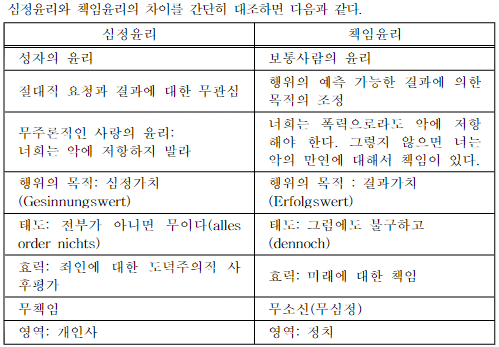
Gesinnungsethik, Verantwortungsethik
그런데 바로 절대윤리는 '결과'를 묻지 않습니다.
We must be clear about the fact that all ethically oriented conduct may be guided by one of two fundamentally differing and irreconcilably opposed maxims: conduct can be oriented to an ‘ethic of ultimate ends’ or to an ‘ethic of responsibility.’ This is not to say that an ethic of ultimate ends is identical with irresponsibility, or that an ethic of responsibility is identical with unprincipled opportunism. Naturally nobody says that. However, there is an abysmal contrast between conduct that follows the maxim of an ethic of ultimate ends—that is, in religious terms, ‘The Christian does rightly and leaves the results with the Lord’—and conduct that follows the maxim of an ethic of responsibility, in which case one has to give an account of the foreseeable results of one’s action.

여기에 결정적인 점이 있습니다. 윤리에 따라서 지향된 모든 행위가 서로 근본적으로 다르고, 중재할 수 없을 정도로 대립된 두 원칙하에 있을 수 있다는 것을 우리는 분명하게 알아야 합니다. 즉, 모든 행위는 '신념윤리(Gesinnungsethik)'에 따라서 지향될 수 있거나, 아니면 '책임윤리(Verantwortungsethik)'에 따라서 지향될 수 있습니다. 이 말은 신념윤리가 무책임(verantwortungslosigkeit)과 똑같으며 책임윤리는 무신념(Gesinnungslosigkeit)과 똑같다는 것을 뜻하지 않습니다. 이것은 당연히 문제 밖의 일입니다. 그렇지만 사람이 신념윤리의 원칙에 따라서─종교적으로 말하면, '기독교도는 올바르게 행할 뿐이며, 그 결과는 하나님에게 맡긴다'[는 식으로]─행동하느냐, 아니면 자기 행위의 (예측할 수 있는) 결과에 대해 책임을 져야 한다는 책임윤리의 원칙에 따라서 행동하느냐라는 이 두 태도 사이에는 한없이 깊은 대립이 있습니다.
p.41.
이에 반해 책임윤리를 따르는 사람은 인간의 바로 저 평균적인 결점을 고려하여(왜냐하면 피히테가 올바르게 말한 바와 같이, 그는 인간의 선함과 완전함을 전제할 권리를 전혀 갖고 있지 않기 때문입니다), 또한 자기 행위의 결과를 예측할 수 있었던 한에서는 그 결과를 다른 사람들에게 떠넘길 수 없다고 생각합니다. 그는 '이런 결과가 된 것은 나의 행위 탓'이라고 말할 것입니다.
No ethics in the world can dodge the fact that in numerous instances the attainment of ‘good’ ends is bound to the fact that one must be willing to pay the price of using morally dubious means or at least dangerous ones—and facing the possibility or even the probability of evil ramifications.
p.41.
The decisive means for politics is violence.
p.42.
윤리적 역설
This problem—the experience of the irrationality of the world— has been the driving force of all religious evolution. ... Anyone who fails to see this is, indeed, a political infant.
p.43.
Machiavellianism
Protestantism, Calvinism
Normally, Protestantism, however, absolutely legitimated the state as a divine institution and hence violence as a means.
p.44.
Whoever wants to engage in politics at all, and especially in politics as a vocation, has to realize these ethical paradoxes.
p.45.
Age is not decisive; what is decisive is the trained relentlessness in viewing the realities of life, and the ability to face such realities and to measure up to them inwardly.
p.46.
He then acts by following an ethic of responsibility and somewhere he reaches the point where he says: ‘Here I stand; I can do no other.’
p.47.
정치인
Nur wer sicher ist, dass er daran nicht zerbricht, wenn die Welt, von seinem Standpunkt aus gesehen, zu dumm oder zu gemein ist für das, was er ihr bieten will – dass er all dem gegenüber „dennoch!“ zu sagen vermag: Nur der hat den „Beruf“ zur Politik.

Only he has the calling for politics who is sure that he shall not crumble when the world from his point of view is too stupid or too base for what he wants to offer. Only he who in the face of all this can say ‘In spite of all!’ has the calling for politics.
p.48.
대화
2026. 6. 1. 10:30 이양수 선생님께 대한 나의 질문
지난번 같이 읽은 베버의 <직업으로서 정치>에서 함께 고민해보면 좋을 생각이 나서 공유 드립니다.

신념윤리라 번역된 Gesinnungsethik은 칸트의 심정Gesinnung과 연관을 갖는 개념으로 보입니다. <이성의 한계 안에서 종교>에서 논의되었듯이, 자신의 이해관계가 아니라 도덕적 의무를 요구하는 마음이며, 동시에 행위의 기준이 되는 준칙Maxime을 채택하려는 내적 지향입니다.

칸트의 심정은 믿음Glaube에서 비롯됩니다. 도덕적 최고선은 인간의 이성으로는 도출해낼 수 없어 반드시 신이라는 절대적 존재를 요구하는데, 이때 갖게 되는 마음이 믿음입니다.

이에 반해 헤겔은 절대적인 신을 요청하지 않고도 자기Selbst의 자유만으로 도덕을 넘어선 인륜적 행위가 가능하다고 봅니다. 이때 요구되는 것은 자기의 확신Gewissheit이고, 그 확신은 도덕적으로 양심Gewissen이라는 형태로 나타납니다. 양심을 가진 행위자는 자기 행위에 책임을 지기 때문입니다.

신념윤리는 이런 배경에서 비롯된 것으로 보이고, 결론부에 나타난 책임윤리와의 대조는 도덕적 행위에 대한 칸트와 헤겔의 관계를 함께 검토할 때 더 깊이 이해해볼 수 있겠다는 생각입니다.

굳이 도덕Morale이 아니라 윤리Ethik라는 개념을 채택한 것도, 칸트류의 합리적 도덕성이 정치 영역에서는 적용되지 않는다는 입장을 반영한 것으로 보입니다. 그렇다고 헤겔과 완전히 동일하냐 하면, 그것도 또 아니겠지만요.
2026. 6. 1. 13:30 이양수 선생님의 답변
심정이 윤리의 근간임은 부인하기 어려워 보입니다. 아리스토텔레스도, 스피노자도 모두 특정의 감정 상태가 윤리의 시작임을 인정합니다. 칸트도 이 점을 인정하지만, 병리학적 상태에서 벗어나 객관화 (보편화) 되어야 한다고 보았던 것입니다. 신념이 준칙으로, 준칙이 보편적 법으로 이행하는 고정으로 본 것도 이런 맥락입니다. 다만 객관화 과정은 심정의 개인적인 정서 과정을 벗어나 타인과의 관계에서 판단하기 때문에 정서와의 합일은 종교 공동체 역할에 기대하고 있던 것입니다.  헤겔은 개별적인 것에서 이런 통합을 끌어내려고 했다고 봐야 할 것입니다. 확실성으로서 양심은 바로 그 일치 가능성으로 언급됩니다.
도덕과 윤리의 전통적 구분은 터자의 개입에 의한 보편적 동의와 그렇지 않은 영역의 구분으로 보면 좋을 듯싶습니다
 project_Qualia